Look what I found

I love to forage.

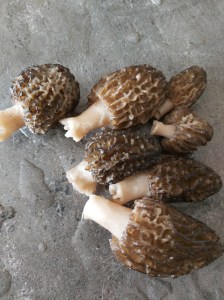
today I found morels, some of the most delicious mushrooms on the planet, they are really hard to find.
They grow in April and May and love sandy soil

Today I shall eat them lightly fried in a little olive oil. Chefs also sauté them in butter, they can also be preserved by canning, bottling or drying. But this is just a nice little portion for one person, laid across a slice of home baked whole grain bread, with the tiniest smattering of salt.

Always check all your mushrooms for worms and bugs and brush them clean with a small soft mushroom brush. Some mushrooms will be covered in sand or other debris. What I do if it is really bad is wash them under cold running water and then leave them to dry separately for several hours or even overnight so they do not become soggy.

Please never ever pick any wild mushrooms unless you have learned personally from an expert in the field.
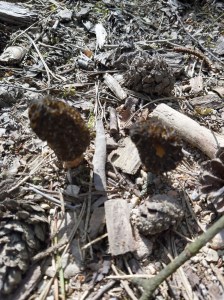
There are, for instance, mushrooms that are often mistaken for morelles  which are poisonous and will make you really quite ill, so unless there is someone with you who is an expert in the field, do not pick.
If you are not sure of what it is, do not pick, if it is not in the best condition, do not pick, if it has been half eaten by slugs or is very damaged, do not pick.
Do not pick if it is very young and do not pick if it is very old.

If you are serious about learning to forage mushrooms, learn when they are not in the right condition to pick.
This is not something you can learn from a book or a few videos. You need to learn from an expert in the field, personally. Some experts run workshops during the relative mushroom seasons and it is possible to apply for these where you are.

I was lucky, my mother picked and so did my grandmother and my aunts and great aunts, so I learned from  childhood which mushroom is which, what is edible, what will make me ill, what is medicine and what will give me (bad) dreams, and, of course which ones are delicious and where to find them, which trees they prefer to be near or grow on, as well as all the places they knew where their favourite mushrooms grew.

I never tell anyone where these mushroom patches are, some are very rare, some are very common, some are very hard to spot, others are extremely easy. I know over fifty varieties, but I only pick some of them. I pick depending on seasonal availability, which can vary greatly from year to year.

If you do come across a mushroom patch never ever pick them all, leave one third – always, – don’t be greedy.
Let some grow up and spore, if you see someone else also knows this mushroom patch and has already picked them, leave what is left. and go your way.

I will not pass my expertise on to anyone, I have no one I want to pass it on to and do not give workshops. We have so little forest left and it is still being cut down at an astonishing rate. There are few wild meadows left and little duneland. Many of the varieties I used to pick are now rare or even endangered. If I do come across a patch of rare mushrooms I leave them alone, even hiding the patches of the rarest ones so no one else can stumble across them.

Morelles can be bought already dried, or in jars or tins, preserved for your recipes and dishes if you really want to try them, very rarely you can get them fresh. There are now growers who specialize in morles too, that would be the best bet.

Better yet find a restaurant where the chef has them on the menu and try them cooked by an expert.
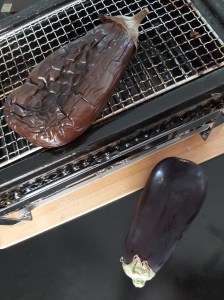


Baba Ganoush

Otherwise known as Aubergine dip or if you don’t even use the word Aubergine, eggplant dip.

A delicious middle eastern recipe that is also simple to make, very nutritious as well as delicious.

It is also possible to play with the flavour profile by adding spices and herbs or even other vegetables.

The recipe.

2 Aubergines
2 cloves of garlic
40ml of olive oil, or 2 tbsp
1/4 tsp coriander
1/4 tsp cumin
40ml Tahini or 2 tbsp
juice of a lemon
salt to taste
finely chopped parsley to finnish.

Grill or roast the Aubergines whole for 35 – 40 minutes, or until blackened and soft.
Allow to cool completely.
Peel or scoop out the flesh.

put all the ingredients into the blender except the parsley,
and mix till it’s a smooth luscious paste.
season to taste, and serve with the chopped parsley sprinkled on top.

super easy and greet as a snack with crackers.

Enjoy.

Sweet vinaigrette.

Recipe

Extra virgin Greek olive oil 1/4 cup
Mirin 4 tbsp
Braggs cloudy apple cider vinegar 1/8 cup
Fine table salt to taste
Fine ground white pepper to taste
White granulated sugar 1/4 tsp
Dijon mustard 1/2 tsp

put in a jar with a lid and shake well till thick and emulsified.

This vinaigrette it is delicious, and not too sour.

Vinaigrette is all about the balance, the exact measure of oil, sweet, sour and salt, with a hint of spiciness.
I find the taste is quite different depending on the exact elements us use, should it be a Greek extra virgin olive oil or do I go for the Spanish which has quite a different flavour?
The mustard, well, just how many kinds of mustard are there?
Some are delicious in vinaigrette and some are only edible on hot dogs.
They can be rough ground or smooth, sweet or very salty, each make is completely different and adds a totally different flavour profile to the vinaigrette.

As for vinegars, there is possibly even more variation, white wine vinegar, Japanese rice wine vinegar, apple cider vinegar. Each with its own unique flavour, so experiment, decide which one to use to get the exact flavour you are looking for.

Sugar, each variety has its own unique flavour, white granulated in this case which has very little flavour, but just adds sweetness. There is deep dark muscovado, or demerara and also jaggery. All these have their own uses, and flavour recipes differently. Sweetners of all kinds have a unique effect on every dish you add them to.

Even salts have subtle flavours from table salt to black Hawaiian or pink himalayan to fleur de sel, and there are more.
I use them all in different recipes and in different ways.

Therefore I think it is important that we are clear in recipes which kind we use, which ones make the exact flavour profile we are looking for.
Each variation in the ingredients gives a variation to the flavour profile of the finished vinaigrette, sauce or dish.

So there are two recipes today

The basic recipe is

oil
vinegar
mustard
salt
pepper
sugar

This gives you the basic ingredients, and the one for todays sweet vinaigrette above, which gives you the exact recipe.

Good luck with experimenting and getting the balance right.
Every time you make a vinaigrette you can try a different mustard, a different oil a different vinegar and so on, and each time get a different vinaigrette.

That is the art of cooking, to experiment with a known recipe, technique or principle and find out what you like best or what goes best with the rest of your dish.
Dare to be different, you can even play with the proportions.
Do you want more mustard? Less salt or more sugar or oil?
What if you use honey or add celery salt instead?

Try it.

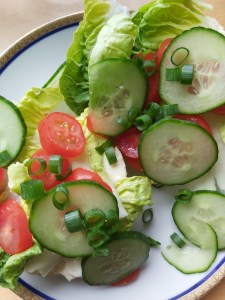
This recipe is great with all kinds of fresh salads, we ate it with little gem lettuce cucumber slices and cherry tomatoes, with a sprinkling of finely chopped spring onion.

Let me know how you get on

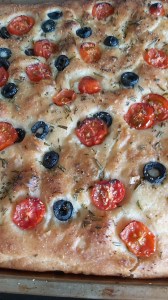
Focaccia, the easy recipe

It is actually incredibly easy to make focaccia.
Give it a try, it is the easiest type of bread to make, anyone can do it.

Before you put it in the oven you can cover it with any topping you like.
This one has tiny tomatoes, chopped black olives and oregano.

Try garlic, onions, rosemary, herbes de provence, chopped courgette or aubergine, paprika, chilli or even kapers.
Dare to experiment. Mix it up for a different eating experience every time.

Here is the recipe.

500g white flour
400ml (warm) water
1 sachet instant yeast
8 tbsp olive oil (and some extra)
1 tsp salt

topping
Tomatoes sliced
oregano
black olives, chopped
olive oil

technique.

First dust a work surface with flour ready for the kneading.

Oil and flour a large flat baking sheet, (16 by 12 inches).

In a large bowl mix the flour, yeast and salt and add the water slowly while you mix to get a soft liquid dough. Use your hands as this is such fun. However a wooden spoon also works.

Pour all the dough out onto the floured surface and knead for about five minutes. It should become smooth and stretchy.

Oil the bowl liberally and put the dough back in it, cover with a cloth and leave to rise for about an hour.

Pour the almost liquid bubbling dough into the baking tin and spread it out evenly with the fingertips,
Don’t worry if it deflates a bit as you push it into the corners.

Cover and leave it to rise for 45 minutes.

Heat the oven at 240c or 465f or gas mark 9 to be ready for the focaccia.

Make holes in the top by poking with the fingertips for the authentic focaccia look and cover with some more oil, add your toppings last, in this case olives, tomatoes and oregano.

Bake for 30 minutes.
When you take it out of the oven add some sea salt and more olive oil.

Eat this warm!

Don’t be afraid of yeast, this recipe always works.

a few tips.
Massage some oil into your hands before kneading, this usually helps to stop the dough sticking.
Do not leave the rising dough in a draft, yeast hates that, as well as the cold. a warm dark spot is best.
Always cover with a clean tea towel.
To avoid the tea towel sticking during the second rise, oil the surface of the dough first.
Make sure tho oven is already hot when you are ready to bake the focaccia.

Let me know how you get on.

Secrets of perfect Couscous

There is a trick to getting perfect couscous, not porridge, which happens if you are not careful, or sawdust, which is also no fun to eat. Getting it right it’s part of the three bears philosophy, not to much, not too little, but just enough.

There are always instructions on the packet, usually this involves using way too much liquid, so be sparing. I find the ratio option works best for me.
Two to one, no more, no less.

So if you measure in cups it’s one cup to half a cup or 200ml. to 100ml.
hot water to couscous.
and a couple of tablespoons of olive oil to smooth it out helps enormously to make a tasty meal, plus salt to taste of course.

Here’s how you do it. Boil the water, turn it off, pour in the couscous, leave it a few seconds and then start fluffing it up with a fork, add a little olive oil as you go, let if fluff it will grow quite a bit. Never add more water. Trust the process.

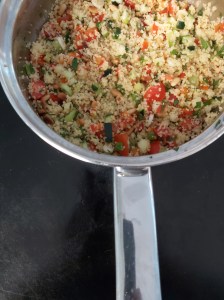
To turn it into this lovely meal, pictured above.

finely chop a 5cm chunk of courgette into 5mm cubes.
finely chop a handful of parsley
Chop a spring onion into slim rings, also using all the green
chop half a paprika into 5mm cubes

Finely chop a chilli, leaving out the pith and seeds for a milder flavour. I prefer cayenne chillies myself. Leave out the chilli if you don’t like the heat.
Add salt and pepper to taste.

This can be eaten as a salad, or the staple with any meal, served just warm or cold.

There are many variations, try different vegetables, whichever you prefer, do not be afraid to experiment.

Enjoy another great vegan dish!